
When cell networks congest or fail, at a festival, in the backcountry, during a disaster, phones stop being useful for the one thing you need them for. The existing answers each ask for something in return: dedicated hardware, a sky view and a subscription, or a tolerance for messages that may or may not have arrived.
What It Is
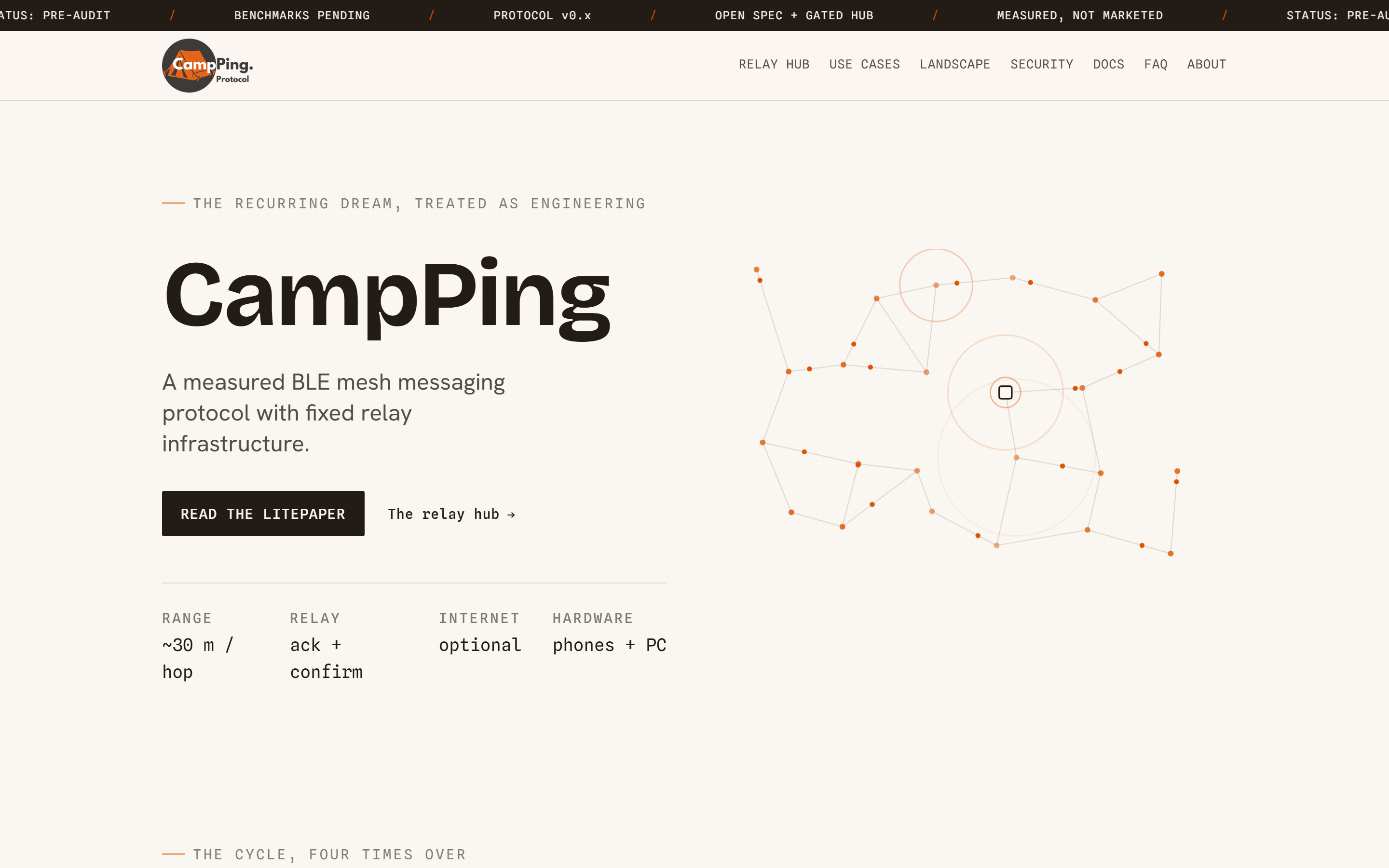
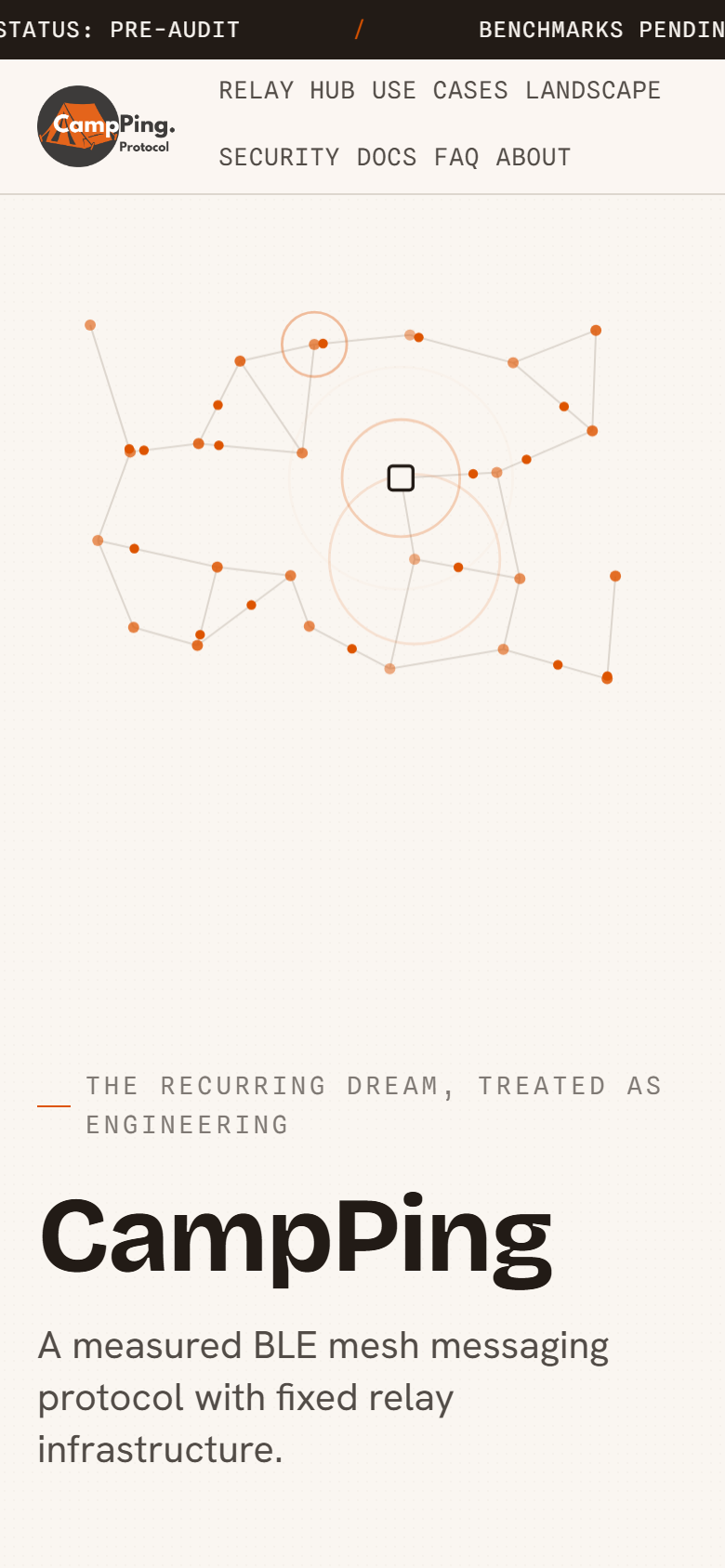
A Bluetooth mesh messaging protocol where every phone is both broadcaster and listener, passing messages hand to hand at roughly 30 meters per hop with no internet required. Group messaging, end-to-end encryption, dictionary compression sized for Bluetooth’s bandwidth, and last-known-location mapping. Internet is optional: it adds bandwidth, never a dependency. Cross-platform across iOS, Android, and Windows.
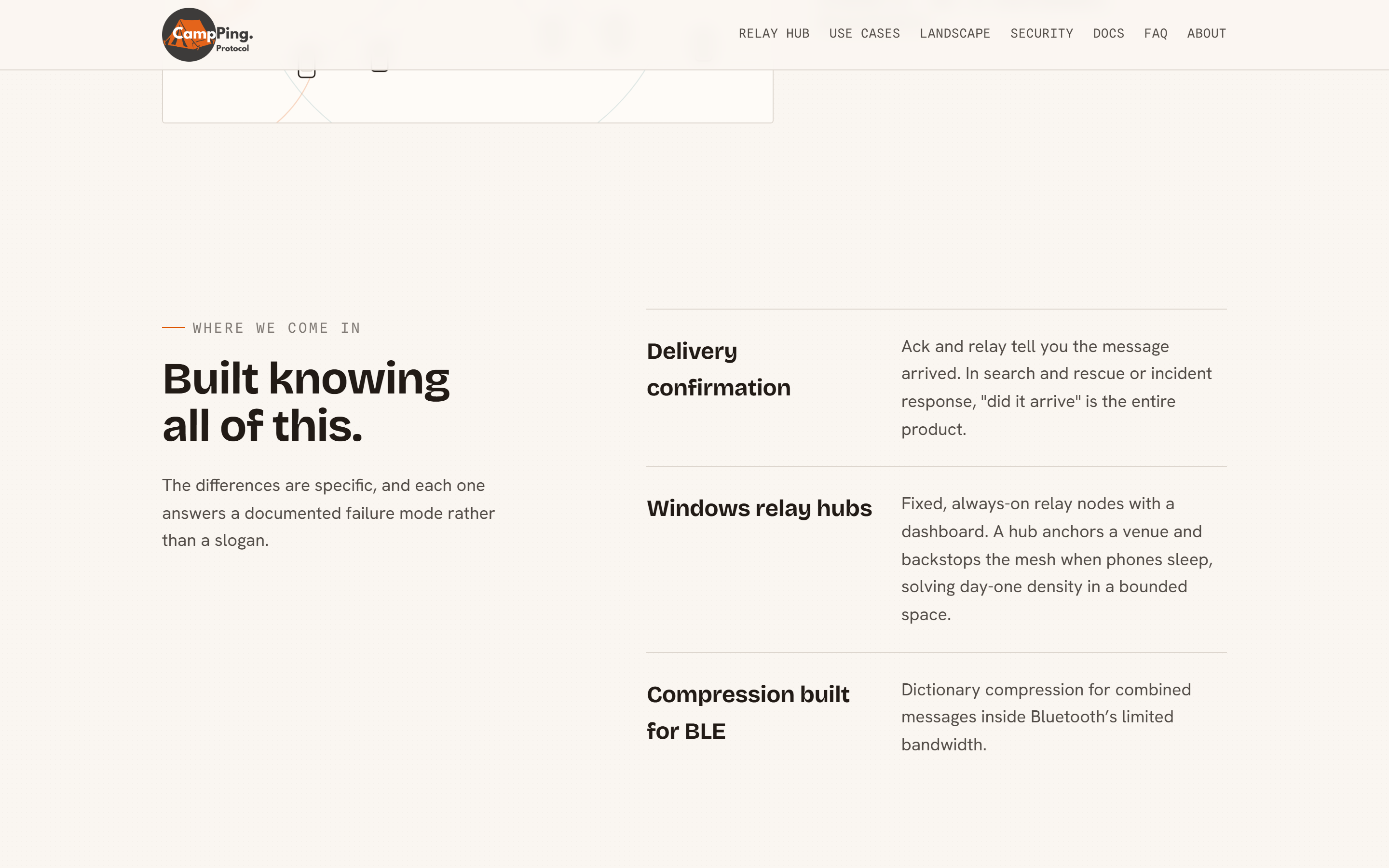
The part that is actually different is delivery confirmation. Ack and relay tell you the message arrived. In search and rescue or incident response, “did it arrive” is the entire product, and a broadcast you cannot confirm is a guess.
The second part is fixed infrastructure. Windows relay hubs are always-on nodes with a dashboard, aggregating and forwarding per device. A hub anchors a venue and backstops the mesh when phones go to sleep, which is the mitigation for Apple suspending Bluetooth advertising the moment an app leaves the foreground. It is also the commercial line: the protocol is open, the operational layer is not.
Why This Category Keeps Failing
For fifteen years the same idea has launched, gone viral from a blackout or a crowd rather than from marketing, and collapsed the same three ways. Security researchers break the crypto. Or the crowd disperses and the mesh goes quiet, because a mesh with no nearby users is only a phone. Or the team learns that people will not pay for an app they need once a year.
Building it while knowing all of that is the actual design constraint. Cold start, iOS backgrounding, and a consumer price permanently anchored at zero are the three walls, and each one has an answer here rather than a slogan.
The Discipline
Claims broke this category, so this one publishes benchmarks instead.
No performance numbers appear anywhere, on the public site or on this page, until the test campaign runs. When they do, the set is fixed in advance: delivery rate by hop count, latency with ack round trip, throughput after compression, battery cost per hour relaying, and the honest iOS degradation curve, each measured with and without a hub. Independent security audit before a single word of marketing aims at high-risk users. Thresholds are written down before testing starts, so the goalposts cannot move after the data lands.
Consumers ride free by design. The organizations responsible for other people’s safety are who pays.
Status
Pre-audit and benchmarks pending. The protocol now has a public name, CampPing, though the site still routes every mention through a single config value rather than hardcoding it. The site says all of this in a status strip across the top of every page: the disclaimers are the chrome, not the fine print.
Stack
The public site is Astro with Starlight docs, TypeScript, Tailwind, and Cloudflare Pages. A build-time claims guard scans the compiled output and fails the build on unearned statistics or pre-audit language, which is the mechanism that keeps the marketing surface from outrunning the evidence.