A library of design references where nothing is stored without a reason attached, and a ledger recording which project used which reason.
The Problem
Every project in this vault has a design/brand.md and a tokens.css. They pin down values: this hex, that spacing step, this font. An agent given those files still produces generic work, because the files say what the values are and say nothing about what was rejected to arrive at them. Tokens carry no taste. Everything the tokens do not cover gets filled in from model defaults, and model defaults are the same everywhere.
Measuring the two most-visited surfaces made the size of the gap concrete. The games hub ships 592 hardcoded hex literals across 227 distinct colours, and the ten most frequent are the Tailwind default ramp. The marketing site looks compliant at 478 var() usages, but its canonical token file is never imported: the shipped stylesheet is a separate hand-kept copy missing every font and radius token, so those are hardcoded by name instead.
A folder of screenshots does not fix this. An agent cannot read a JPEG at generation time, and a screenshot records no decision.
What It Is
Two views of one dataset.
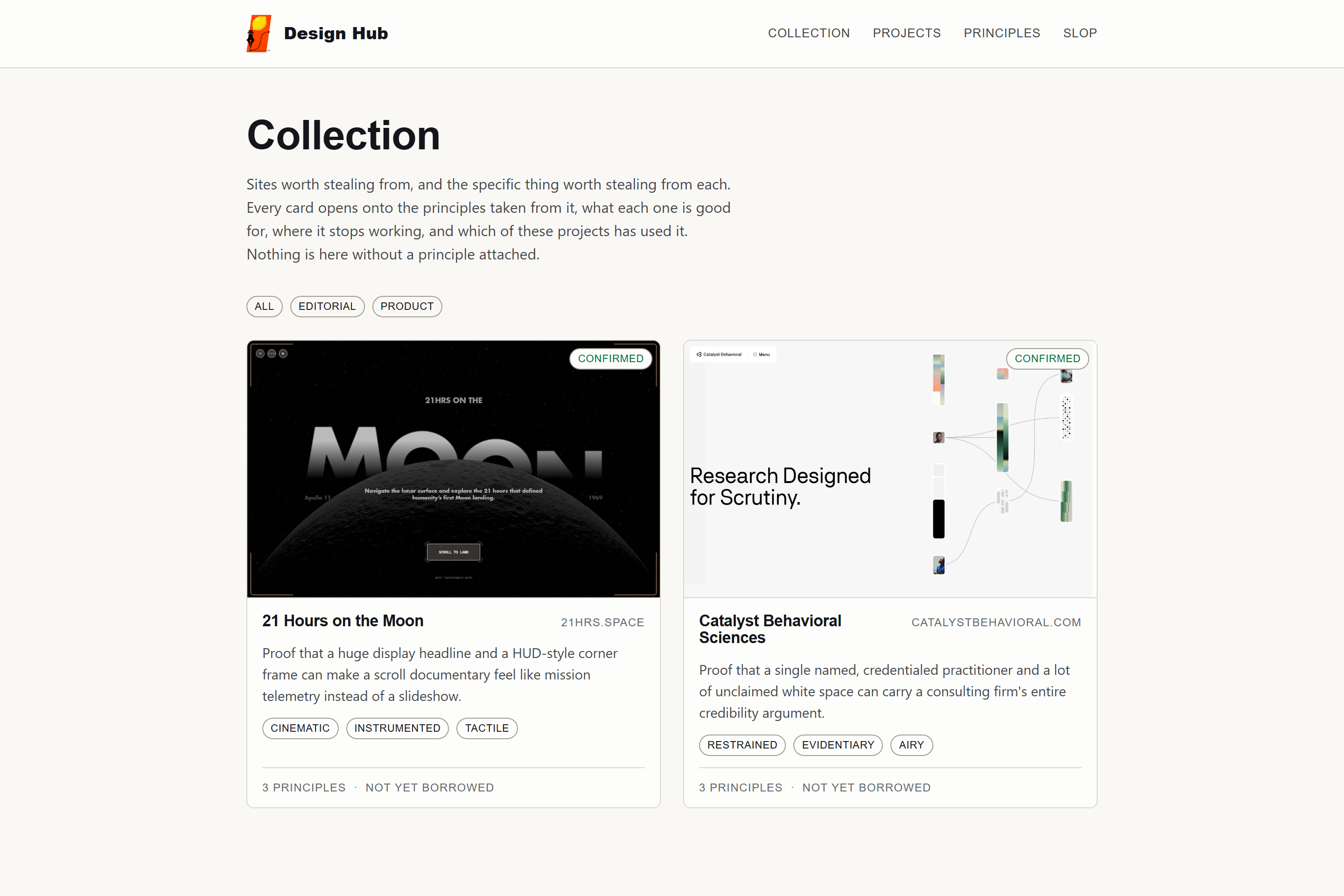
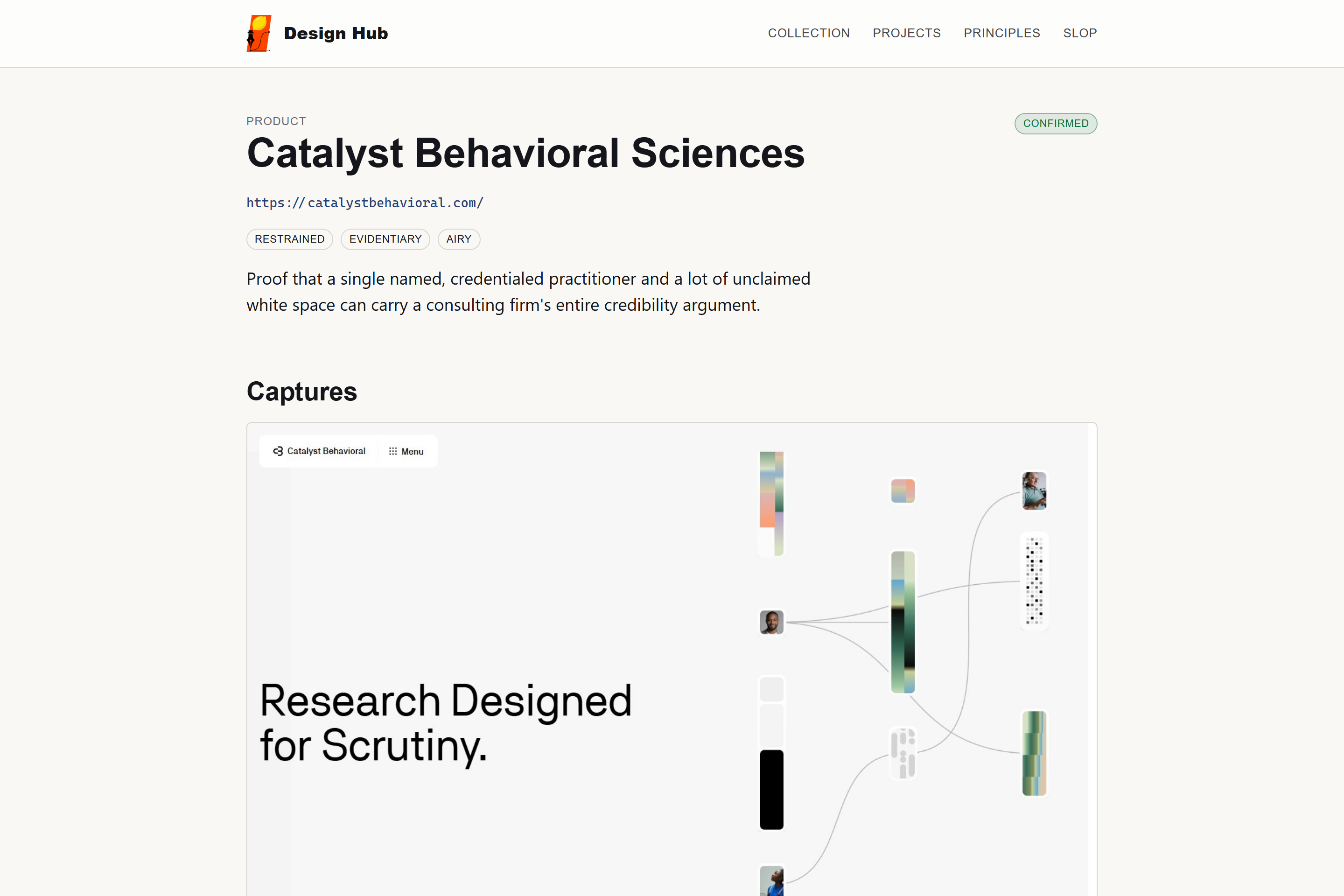
The references are sites worth stealing from. Each one carries principles written as imperatives, and each principle states three things: the rule, the evidence on the page that demonstrates it, and where it stops working. That last field is the one that matters. “Set section padding to 96px minimum and never compensate by tightening line-height” is a rule. “Uses generous spacing” is a preference.
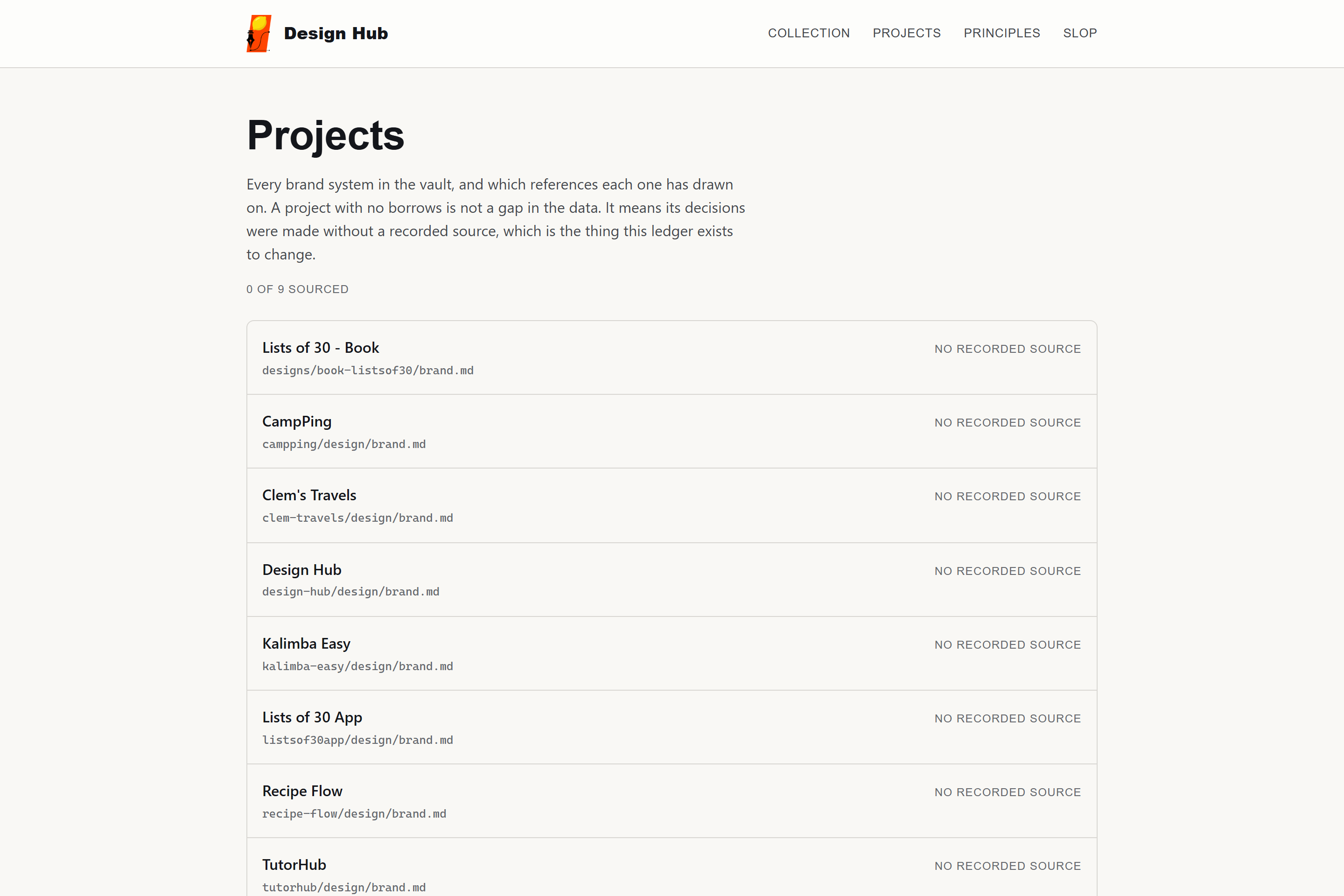
The borrow ledger records what was actually done with each principle: which project, which surface, one sentence in past tense, and whether it was kept or reverted. Reverted entries are required rather than tolerated. A ledger of only successes records taste that was never tested.
Both compile to inspiration-index.json, which is what the inspiration-library skill reads before any UI work in the vault. It resolves in both directions: which references informed a project, and which projects used a principle.
Precedence Is Fixed
The skill states a five-rank ladder and does not renegotiate it per session. The target project’s own brand file always wins. The sourced principles rank below it. The slop tells, a list of specific defaults this vault refuses, act as negative constraints that yield to the brand file. Generic taste skills rank last and are advisory.
Two inversions get named explicitly, because both were observed in practice. A slop tell is not a veto over a brand file: when they disagree, the brand file wins and the tell does not apply. And a generic skill’s aesthetic advice never outranks a brand file, which the code-reviewer agent previously guaranteed it would, by handing out three taste skills while forbidding the agent from reading brand files at all.
Nothing Publishes Without a Human
A reference stays invisible until a human confirms it. Draft entries are excluded from the site, from the index, and from the deployed assets. The capture pipeline writes the measurements and leaves every judgment field blank, and the command that runs it is forbidden from filling them in.
This is enforced in three places rather than documented in one:
- The confirmation gate. Status flips by hand, or by an explicit instruction naming the reference. Never by inference.
- The asset gate. Screenshots mirror to the build confirmed-only by default. A postbuild step reads each reference’s real frontmatter and fails the build if the output carries any unconfirmed capture. This exists because the safe default alone was not enough: the mirror directory persists between runs, so a local-review build followed later by a deploy build republished every draft.
- The aggregator guard. Showcase sites are rejected at capture. A Behance gallery captured cleanly, returned HTTP 200, reported extraction complete, and produced a full token file describing Behance rather than the work, which was a hundred lazy-loaded images no DOM extractor can read. A confident, complete, entirely wrong entry is the failure mode a library like this has to design against, and it does not announce itself as an error.
Accessibility Found Two of Its Own Bugs
Shipping this added a design and accessibility stage to the vault’s pre-launch audit, checked against a running server rather than source files. Contrast, keyboard operability, visible focus and form labels block a launch; the rest warn.
Its first run was against this site, and it failed. Two colour tokens shipped under the WCAG AA floor: the muted text token at 4.04:1, used for captions, table headers and the sourced count, and the draft badge at 3.91:1 against its own tinted fill. Both were darkened and re-measured clean.
The audit tool itself was wrong twice before it was right. It scored a dark banner with white text at 1.01:1, because these tokens are authored in oklch() and the browser returns oklch() unchanged, so scraping numbers out of the string read lightness and hue as red and green. Then it scored a translucent badge against its own unblended fill instead of compositing it over the page behind. Only after a self-check asserting that black on white is 21:1 and white on white is 1:1 were any of its numbers worth acting on.
Current State
Live, with two confirmed references and two still in draft. The projects page reads 0 of 9 sourced, which is the honest state: every brand system in the vault has made its decisions already, and none of them yet cite where the decision came from. Closing that gap is the point of the ledger, and it is deliberately manual.