A group of us dads in Northend Central Park, Denver, run a poker night. It lands somewhere between every two weeks and once a month, and the WhatsApp thread that keeps it alive is called Poker Friday. Most of us are there for the table, not the theory. Nobody wants a lecture on pot odds between hands, but everyone would quietly like to stop misplaying a flush draw. So I built the trainer for the crew, and named it after the group. Poker Friday is where you get the reps in before the real one, so the math becomes second nature and the night stays about the people.
I play cards, and I wanted a way to practice Texas Hold’em with no account, no real money, and no internet connection. Most poker apps push you toward chips you can buy. This one is a trainer: you play hands, and a coach explains the math while you do.
What It Is
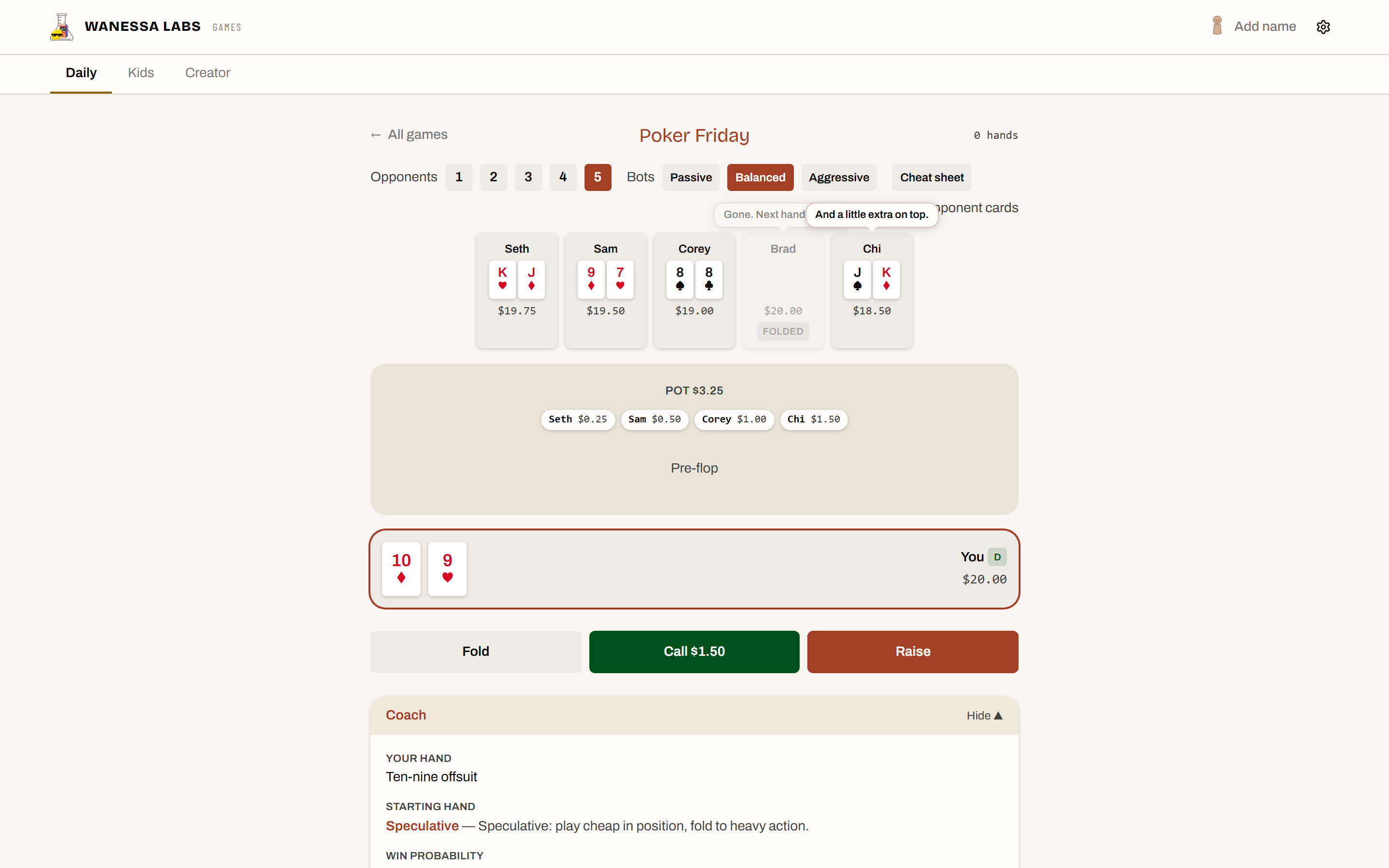
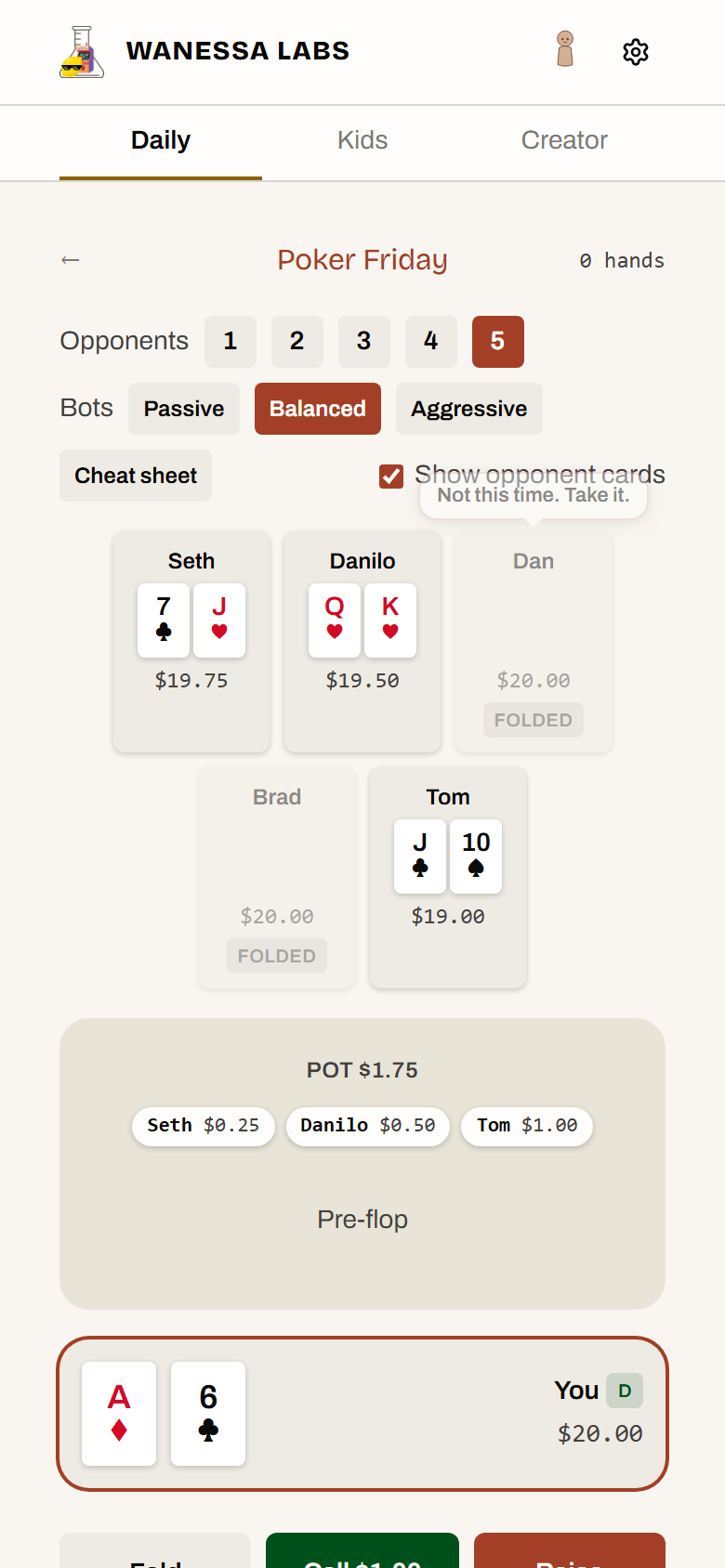
Single-player Texas Hold’em against one to five bots, built as a React game module inside the Wanessa Labs Games Hub. Play money only, no accounts, no network calls during play, fully offline. It implements the hub’s GameProps interface and shares the hub’s design language.
The Coach
The point of the game is the teaching layer. Every street, a coach panel shows:
- Your current hand, and the best hand you can still make
- Your win probability, run as a live Monte Carlo simulation in a background Web Worker so the table never stalls
- Your outs and the Rule of 2 and 4 estimate
- The pot odds, and whether a call is priced right
- A pre-flop strength tier for your two cards
Every number comes from the same hand evaluator the game uses to decide winners. There is no second, hand-wavy math for the coach.
Home Game Rules
The trainer hides two rituals from a real kitchen table game. Nothing in the interface hints at either one. You find them by playing.
Social. When every player is still in as the flop comes down, the table calls it. Confetti, a banner reading SOCIAL, and every player at the table saying “Cheers!” at once. It costs nothing and changes nothing. It marks the moment nobody backed out.
House rules. These are play chips, and the table settles up in them. Win a pot with four of a kind and every other player owes you a dollar. A straight flush is two dollars. A royal flush is three. Folded players pay too, because you pay for missing the fireworks.
Nobody pays more than they have. If a player is down to forty cents, forty cents is what they pay, and the banner reports the real total instead of a number nobody could cover. Paying can bust you, even on a hand you folded.
The bonus never touches the code that decides who wins. Poker math has to be provably right, so a house rule that moves chips runs as a separate step, after the hand is already settled. The test that matters most counts every chip on the table before and after, and the totals have to match. The rule can move money sideways. It can never invent it.
Features
- One to five bots with a table temperament you set: passive, balanced, or aggressive
- Correct hand evaluation, side pots for all-ins, and split-pot handling
- Per-street bet display so you can read what it costs to call
- A reference tab with hand rankings and a short glossary
- Play-money buy-in with unlimited rebuys, tracked honestly
- Two hidden home game rules that fire on their own during play
Stack
| Tool | Role |
|---|---|
| React + TypeScript | Game module inside wanessalabs-games |
| Web Worker | Monte Carlo equity, off the main thread |
| Tailwind | Hub-consistent styling |
| Cloudflare Pages | Hosted inside the wanessalabs-games hub |