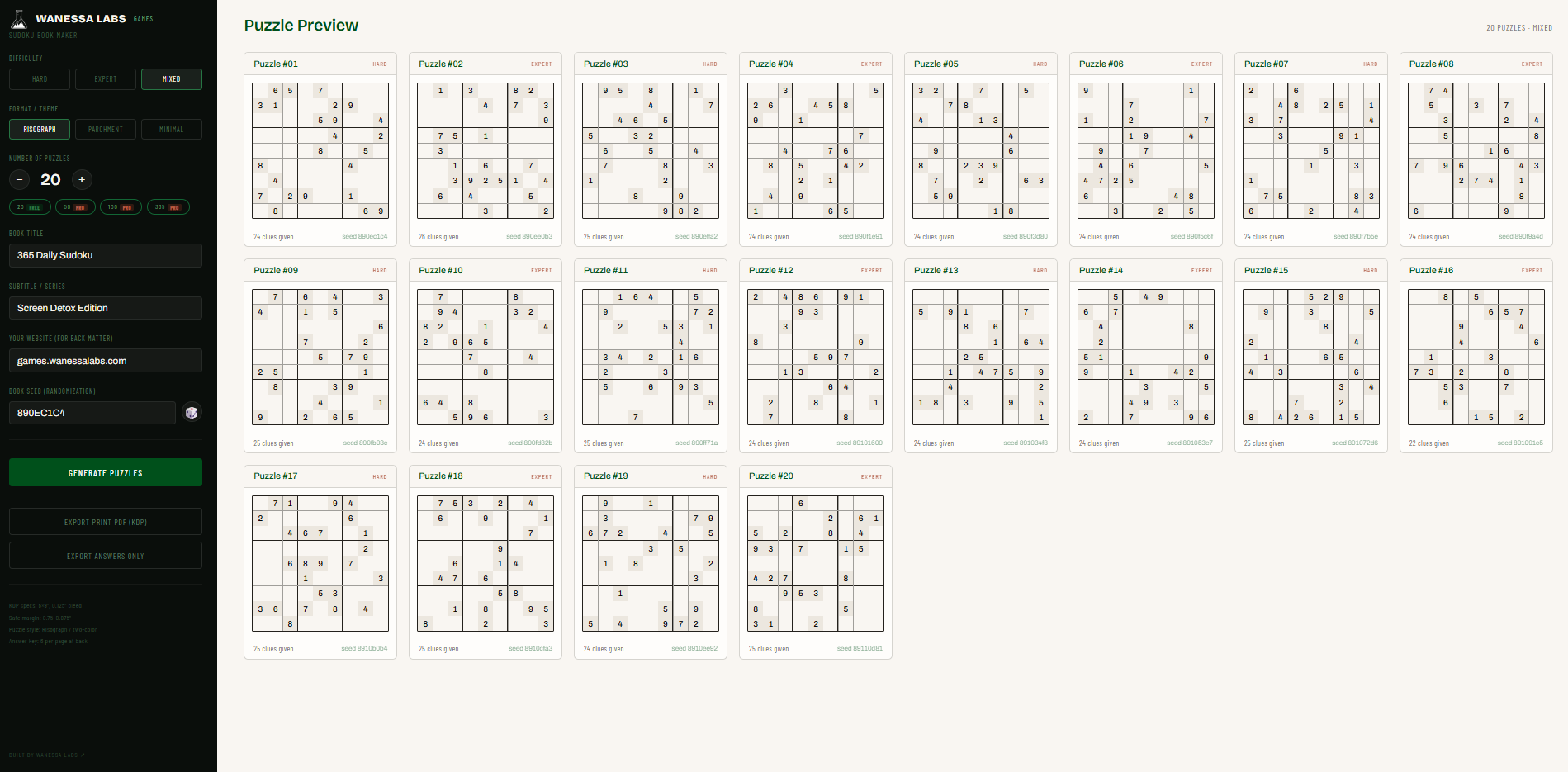
Four free tools for generating and exporting puzzle books, all running in the browser. Choose a puzzle type, set a count, pick a seed, preview every page as it will print, then export a KDP-ready PDF with cover, intro, puzzles and a full answer key. No account. No server. The engine runs on your machine.
The Problem
KDP is an obvious revenue channel for puzzle books. The toolchain is the problem. Dedicated generation software costs money and exports books that look like everyone else’s. Custom layout in InDesign is slow. Paying someone to produce two hundred verified puzzles per book does not repeat.
The first version solved this for Sudoku alone, as a standalone page. Adding a second puzzle type would have meant a second copy of the page arithmetic, the theme system and the PDF writer. So the engine was pulled out and the makers were rebuilt on top of it.
The Four Makers
| Maker | What it prints |
|---|---|
| Sudoku | Nine by nine, two puzzles a page, six answers a page. Easy, medium and hard, mixed to taste. |
| Linked | Sixteen words hiding four groups of four. Drawn from a hand-written bank, so a book never repeats a puzzle. |
| Anagram | Seven letters with one in the middle, every word using the centre. The same puzzles the daily game uses. |
| Mini Crossword | Five by five, clues beneath, filled grids in the back. |
Mini Crossword is the honest exception. Its generator and renderer are finished, but a five by five needs every row and every column to be a real word, and that takes a word bank of a few thousand entries with a clue written for each. The bank is being authored by hand. Until it is deep enough to fill a grid, the maker shows exactly how far along it is and refuses to generate, rather than handing over an empty book.
One Engine, Three Renderers
Every maker describes a page as a list of drawing operations. Nothing about layout knows what a PDF is. Three renderers consume that same list:
- PDF for the book itself, via jsPDF.
- SVG for the on-screen preview, which is why the preview is the page that will print rather than a drawing of it. Generate builds the book and shows every page; a separate button writes the file.
- PPTX for the front matter, because Canva imports PowerPoint. Export the cover, title and about pages as editable slides, redesign them, and drop them back into the book.
A second layout implementation for the preview would have drifted from the PDF the first time either was touched, and the drift would have surfaced as a complaint rather than a failing test.
Configuration
| Setting | Options |
|---|---|
| Puzzle type | Sudoku, Linked, Anagram, Mini Crossword |
| Difficulty | Per maker. Sudoku and Anagram mix easy, medium and hard by weight |
| Puzzle count | Stepper and presets, capped at 200 printed pages |
| Page size | KDP 6×9, US Letter, A4 |
| Theme | Risograph, Parchment, Minimal |
| Book title, subtitle, website | Printed on the cover, title page and back matter |
| Book seed | Manual or randomised. The same seed and settings rebuild the same book |
Reproducibility
Every maker draws from one seeded stream, and each puzzle’s seed is derived from the book’s seed by label rather than by consuming the stream in order. The practical consequence is worth stating: if puzzle nine takes a different path, it cannot change what puzzle ten produces. A seed reproduces a book exactly, not approximately.
Sudoku verifies a single solution before a puzzle ships. No ambiguous grid goes into a book.
Stack
| Tool | Role |
|---|---|
| React + TypeScript | The makers, inside the Wanessa Labs Games hub |
| jsPDF | Client-side PDF, bundled rather than fetched, so a book exports offline |
| pptxgenjs | The Canva front matter export, loaded only when asked for |
| Cloudflare Pages | Static hosting |
KDP print specs are baked into the renderer: 6×9 inches, 0.125 inch bleed, 0.75 to 0.875 inch safe margins.
The original standalone Sudoku maker is still published and still the only way to make four by four and six by six kid packs, plus the growing pack that steps a child up through all three sizes.